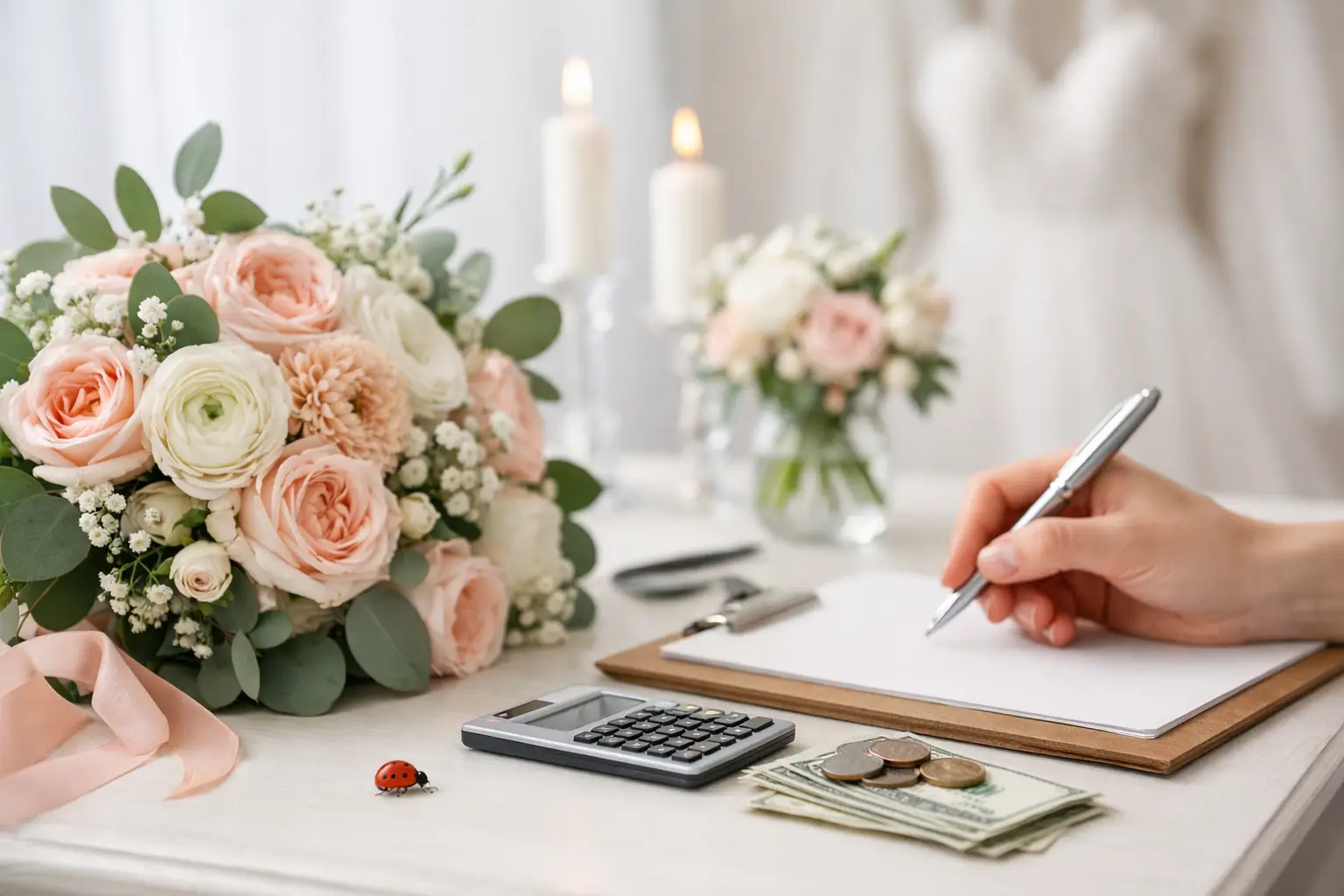
Sticker shock usually shows up right after the bouquet inspiration board. One minute you are saving soft garden roses and candlelit reception photos, and the next you are wondering how flowers became one of the bigger design costs of the day. A practical wedding floral budget example can make that moment much easier, because it turns vague ideas into real decisions.
Flowers are not just one line item. They are personal flowers, ceremony pieces, reception designs, delivery, setup, labor, and the seasonality of what you love. That is why two weddings with the same guest count can land at very different totals. The best floral budget is not the cheapest one. It is the one that puts your money where guests will notice it most and where it matters most to you.
A wedding floral budget example for a 100-guest wedding
Let’s use a fairly common scenario: a 100-guest wedding with one wedding party, a ceremony space, and a reception with round guest tables. This example assumes a mid-range floral style with fresh flowers, a cohesive color palette, and a few statement moments without going fully lush at every turn.
Personal flowers
Personal flowers are usually the easiest place to start because the quantities are clear. In this example, the bridal bouquet might range from $175 to $300 depending on flower choices and fullness. Bridesmaid bouquets often fall between $65 and $110 each. If there are four bridesmaids, that puts the total around $260 to $440.
Boutonnieres are typically more modest, but they still add up. A groom’s boutonniere may be $20 to $35, while additional boutonnieres for groomsmen, fathers, or grandfathers can run $15 to $25 each. Corsages for mothers or grandmothers often land between $30 and $45.
For one bride, four bridesmaids, one groom, four groomsmen, and four family corsages or boutonnieres, personal flowers could reasonably total $700 to $1,100.
Ceremony flowers
Ceremony flowers can be beautifully simple or highly architectural. That is one of the biggest budget swing areas. If you choose two floral arrangements to frame the altar or ceremony backdrop, you may spend $250 to $600 each depending on size and flower selection. Ground meadow pieces, aisle markers, and floral entry arrangements can raise the total quickly.
A modest ceremony setup with two statement arrangements and a few chair or aisle accents may come in around $700 to $1,500. If those larger pieces can be repurposed at the reception, that budget works harder, which is often one of the smartest ways to stretch floral dollars.
Reception flowers
Reception florals usually take the largest share of the budget because they involve more tables, more mechanics, and more labor. If you have ten guest tables for 100 guests, centerpieces become the deciding factor.
Low centerpieces may range from $85 to $175 each. Tall centerpieces often start higher, around $175 to $350 or more. A mixed approach is common and often looks more layered than making every table the same. For example, if six tables use low centerpieces at $120 each and four tables use taller or more elaborate designs at $225 each, the guest table total is about $1,620.
Then there is the head table, sweetheart table, cake flowers, bar flowers, welcome table, and anything you want near signage or guest book areas. A sweetheart table design may be $150 to $400. Cake flowers could be $35 to $100 depending on how floral you want the cake to feel. Small accent pieces for cocktail tables or welcome displays may add another $150 to $400.
A reception floral total for this type of wedding often lands between $2,000 and $3,200.
Delivery, setup, and on-site labor
This is the part couples sometimes forget to include when they compare online flower math to a professionally designed event. Wedding flowers are not only about stems. They also involve ordering, processing, design time, transportation, careful installation, and often breakdown or pickup.
For a full-service wedding, delivery and setup may range from $200 to $700 depending on venue access, installation complexity, timing, and whether there are multiple locations. If arches, hanging pieces, or large-scale installs are involved, labor increases.
The full sample total
Put together, this wedding floral budget example for 100 guests could look like this:
Personal flowers: $700 to $1,100 Ceremony flowers: $700 to $1,500 Reception flowers: $2,000 to $3,200 Delivery and setup: $200 to $700
That places the overall floral budget at roughly $3,600 to $6,500 for a polished mid-range wedding. Some weddings fall below that. Many go above it. The final number depends on style, flower varieties, and how much floral presence you want guests to feel the moment they walk in.
Why one couple spends $2,500 and another spends $8,000
The biggest factor is not always guest count. It is floral density. A bouquet made mostly of standard roses and greenery will price differently than one packed with premium garden roses, ranunculus, peonies, or orchids. The same goes for centerpieces. A compote with airy blooms and negative space feels different from a dense, overflowing arrangement with premium flowers in every direction.
Season matters too, though maybe not in the way most couples expect. Some flowers are available year-round, but availability and pricing still shift. If your heart is set on a bloom during a tight supply window, your florist may suggest a lookalike that keeps the color and texture you love without pushing the budget unnecessarily.
Venue design also changes the floral plan. A ballroom with neutral walls and no built-in character usually needs more floral presence than a garden, chapel, or venue with dramatic architecture. Sometimes the venue does half the decorating for you. Sometimes it does almost none.
Where to spend if your budget is limited
If you cannot do everything, focus on the places that appear in photos and shape the guest experience. Personal flowers matter because they are close to you all day and show up in nearly every portrait. After that, think about one strong ceremony focal point and reception centerpieces that fit the room.
A good florist will often suggest concentrating your budget instead of spreading it too thin. Ten under-scaled centerpieces and a tiny bouquet rarely feel as satisfying as a beautiful bouquet, one meaningful ceremony moment, and simple but intentional table flowers.
Repurposing helps. Ceremony arrangements can move to the bar, sweetheart table, or reception entrance. Bridesmaid bouquets can be placed in vases at the reception. Bud vases mixed with candles can soften the cost of full centerpieces while still making tables feel finished.
Where couples tend to overspend without realizing it
The most common issue is trying to copy editorial inspiration without matching the real budget behind it. Many online wedding photos feature premium blooms, large installations, and layered rentals. The look seems effortless, but the mechanics and stem count are not small.
Another issue is underestimating the effect of “just one more thing.” A few aisle markers, a cake meadow, floral chair tie-ons, bathroom bud vases, cocktail table flowers, and welcome sign sprays can quietly add several hundred dollars or more. None of these are wrong. They simply need to be chosen on purpose.
How to make your floral consultation more useful
Come in with a realistic overall wedding budget and a rough floral number if you have one. Share your venue, guest count, color palette, and the pieces you care about most. Photos help, but it is even more helpful to say what you like in those photos – loose shape, soft color, garden style, modern lines, or fuller centerpieces.
It also helps to be honest about priorities. If your bouquet and ceremony backdrop matter more than reception accents, say that early. A florist can design around that. At RoseAmongThorns, those conversations are where custom work becomes much more personal and much more efficient.
A simple way to set your own number
If you are building a floral budget from scratch, start with three categories: must-have, nice-to-have, and skip-it. Your must-have list may be bridal bouquet, boutonnieres, and guest table centerpieces. Nice-to-have might be aisle flowers or cake flowers. Skip-it could be anything guests are unlikely to notice if the room already feels complete.
Then leave a little breathing room. Flower pricing can shift, and once your design starts taking shape, you may decide one standout feature is worth a bit more. A budget with no flexibility tends to create stress. A budget with a small cushion gives you room to choose well.
Beautiful wedding flowers do not have to mean excess. They just need intention, good guidance, and a plan that fits your day instead of someone else’s inspiration board. If you start with the feeling you want to create and let the numbers support that vision, your flowers are much more likely to feel memorable than merely expensive.